A 20-Hour Flight Into the Future of Money
What Kyrgyzstan's three stablecoins tell us about the emerging nature of money.

Fasten your seatbelts. We are going to Central Asia.

The Kyrgyz Republic does not appear in most conversations about global finance. It is landlocked, mountainous, and home to seven million people. It is also, right now, running three completely different stablecoin experiments simultaneously — one private, one government-issued, one state-backed — each with a different peg, a different backing asset, and a different answer to the question we asked in Part Two: who is responsible?
Nobody planned this. That is exactly the point.
Three stablecoins, before we land
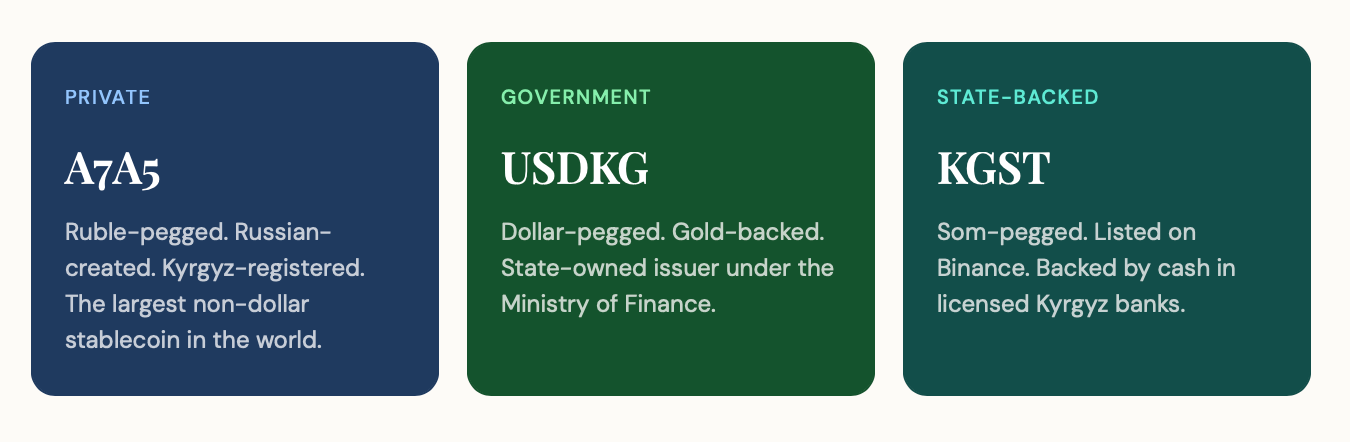
Same country. Same regulatory perimeter. Three instruments that share almost nothing except their address.
The law exists. It just does not say everything.
Kyrgyzstan is not a regulatory vacuum. Since 2022 it has had a formal legal framework for virtual assets — licensing requirements, KYC and AML obligations, mandatory capital thresholds, state registers of licensed entities. By regional standards it is actually ahead of most of its neighbors.
But the framework has a structural peculiarity worth pausing on. Under the Law on Virtual Assets, stablecoins are a recognized category. They have a legal definition. And the authority to regulate them — to set the rules on issuance, collateralization, and circulation — is assigned not to a standing financial regulator with defined prudential standards, but to the President of the Kyrgyz Republic, by decree.
What it means in practice is that three instruments — each with a different peg, a different backing asset, a different issuer structure — all operate under the same legal roof. The framework sets the rules for who can participate. It does not set a common standard for what backing means, what transparency looks like, or what a holder can expect.
That is not unusual for an emerging framework. Most regulatory systems start broad and sharpen over time. The question is when the sharpening happens.

And then there is the yield question
Both MiCA and the GENIUS Act share one notable prohibition — stablecoins cannot pay yield to holders. Two frameworks, built on different continents, with different philosophies about what stablecoins are, arrived at the same answer on this. We explored that in Part Two.
A7A5 pays its holders 50% of the interest earned on its backing deposits. Automatically. Daily. No action required. Just hold the token.
Under Kyrgyz law, there is no equivalent prohibition.
Three stablecoins. No common standard for backing. No common standard for yield. No common standard for what a holder can expect.
Nobody planned this. That is exactly the point.
What is emerging is not one stablecoin model, but multiple competing visions of what digital money should be. In practice, the future of money may evolve less like a global standard — and more like a fragmented map of political priorities, reserve choices, and state ambitions.
References
GRATA International, “Legal Regulation of Virtual Assets in the Kyrgyz Republic: Current Status and Key Trends,” 2026.
CoinDesk, “We do not do illegal things: Inside A7A5’s race to build a crypto giant,” February 2026. coindesk.com
USDKG official documentation. usdkg.com
A7A5 official documentation. a7a5.kg
KGST official website. https://www.kgstoken.kg
Kyrgyz Republic, Law on Virtual Assets, 2022. Cabinet of Ministers Resolution No. 514, September 16, 2022.
Invezz, “Kyrgyzstan launches $50M gold-backed USDKG stablecoin,” November 2025. invezz.com