Small Countries. Big Stablecoin Questions.
All eyes are on yields and who gets the float. Quietly, small countries are asking different questions entirely.

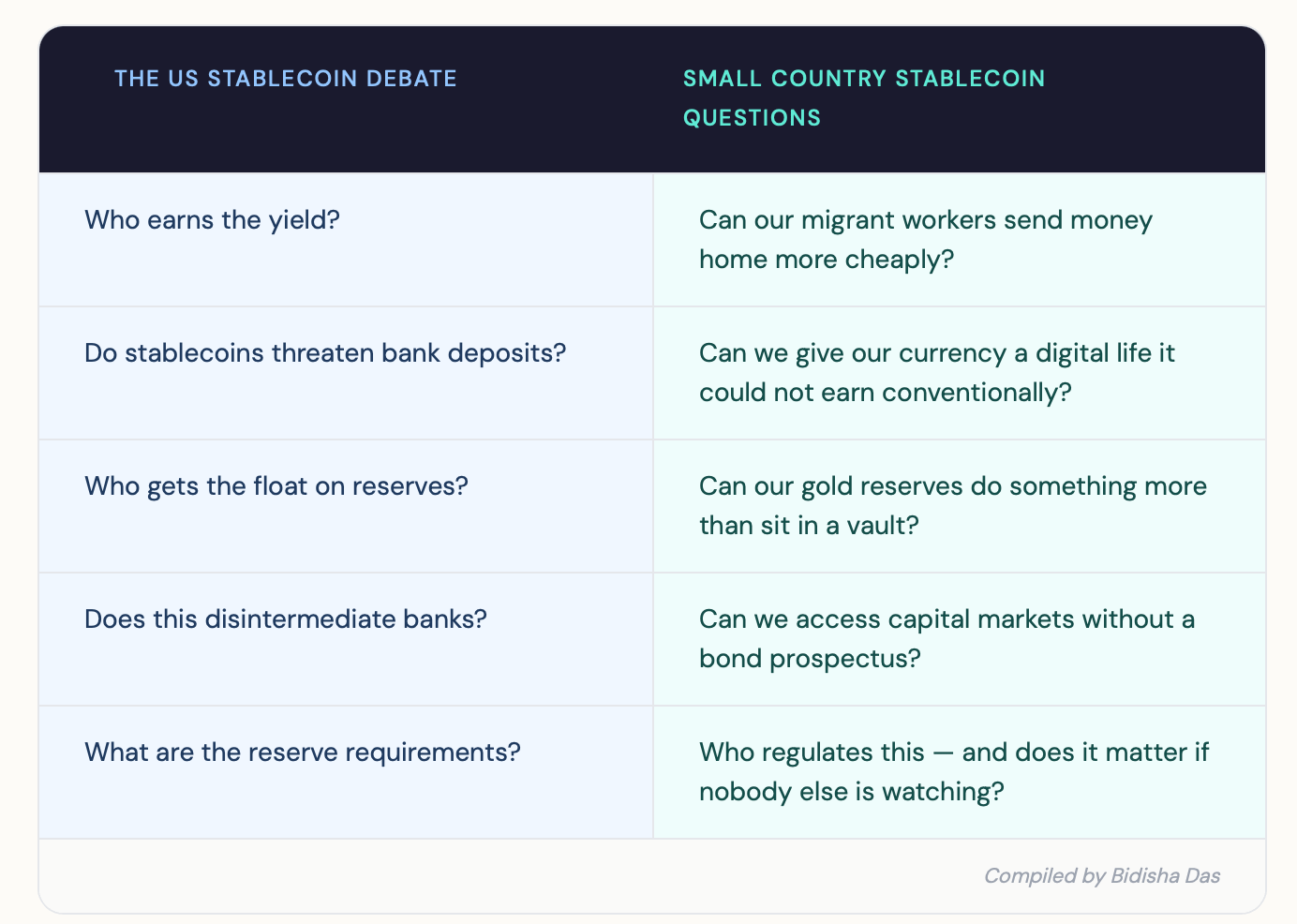
The US debate on stablecoins is, at its core, a debate about money and power. Who issues it. Who earns the yield. Whether stablecoins threaten bank deposits. Whether they disintermediate the financial system. These are real questions — and they are the questions of a large, financially sophisticated country protecting institutions it has spent decades building.
They are not the questions Palau is asking. And they are not the questions Kyrgyzstan is asking either.
Two small nations. Two government-issued stablecoins. Two completely different stories about what digital money is actually for — when you are not the United States.
Palau: one pilot, three agendas
Palau is an archipelago of over 500 islands in the Pacific Ocean. Its population is roughly 18,000 people. It has no central bank. It uses the US dollar — not because it chose to, but because it never had a currency of its own to speak of.
In 2021, Ripple — a US-based blockchain company — began discussions with Palau’s Ministry of Finance about a partnership. The result was the Palau Stablecoin, or PSC, pegged to the dollar, issued on Ripple’s XRP Ledger, and fully collateralized with USD cash deposits held at a Tier 1 FDIC-insured US bank. The Ministry of Finance controlled issuance, distribution, minting, and redemption. Ripple provided the platform and technical resources.
Phase One ran from June to September 2023. It involved 168 volunteer government employees, each of whom received 100 PSC to spend at three participating local merchants. Total PSC in circulation: 20,000 — equivalent to $20,000. The entire programme was funded by a single $25,000 grant from Ripple to Palau’s National Treasury.
The Ministry of Finance controlled the issuance. Ripple provided the infrastructure and the funding. When those two things are true simultaneously, the line between public initiative and private experiment becomes genuinely hard to draw.
The government’s stated motivation was financial inclusion and cost reduction — making payments easier and more affordable, reaching under-served communities, and reducing the transaction fees associated with credit cards and banking services. For a Pacific archipelago where inter-island travel can take hours and physical cash must be physically transported, a digital payment rail has a genuine case to make.
What the citizens actually wanted, though, is telling. When surveyed, 61% of volunteers selected cross-border transfers and remittances as one of the top three most valuable use cases. And 66.7% said they would pay a transaction fee specifically for remittances.
The government said financial inclusion. Citizens said remittances. Ripple wanted a proof of concept. Three different agendas. One $20,000 pilot. The question of what the Palau Stablecoin was actually for depends entirely on whose answer you accept.
Kyrgyzstan: when gold goes digital
Kyrgyzstan is a different case entirely. Not in scale. Seven million people is still a small economy by global standards. But in complexity of motivation.
Start with the problem that is easiest to verify. Remittances accounted for 26.66% of Kyrgyzstan’s GDP as of 2022 — one of the highest ratios in the world, according to World Bank estimates. A substantial portion of that flow comes from Kyrgyz workers abroad, sending money home through corridors that are expensive, slow, and increasingly complicated by recent geopolitical shifts. A government stablecoin that reduces that friction has a genuine case to make.
It is gold-backed. And that is where the motivation gets more interesting.
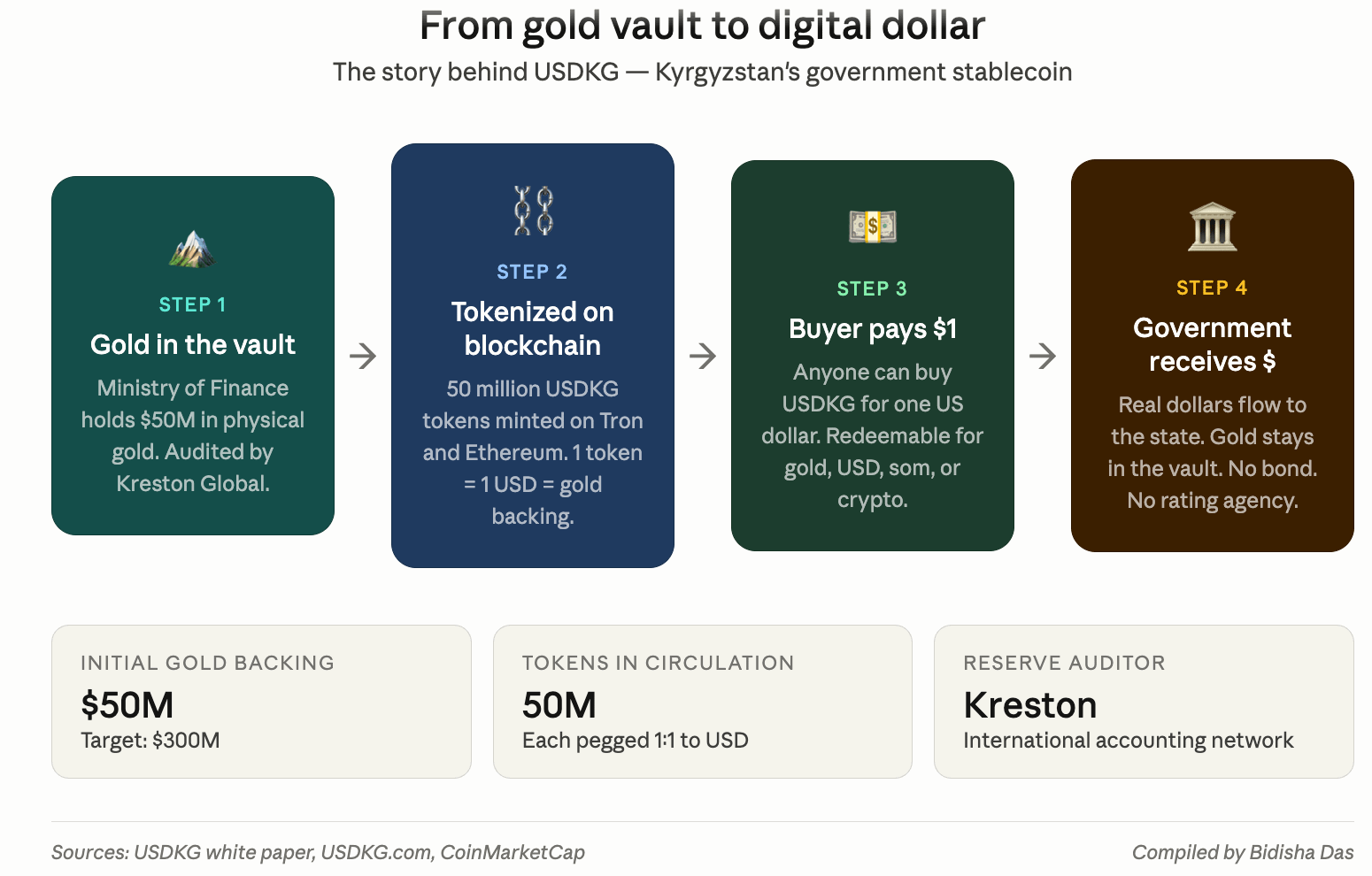
Kyrgyzstan holds significant gold reserves. The Ministry of Finance has allocated $50 million in gold to back USDKG at launch, with plans to expand to $300 million. Gold sitting in a vault generates no income and cannot be easily used to raise money through conventional channels like bond markets, credit facilities, sovereign borrowing. That too without going through rating agencies and formal debt documentation.
USDKG changes that. When someone buys a USDKG token, they pay equivalent of one US dollar. The government receives that dollar. The gold stays in the vault as backing. At scale, this becomes a mechanism for raising real money using gold reserves as credibility outside the conventional sovereign debt architecture. No bond prospectus. No credit rating. No formal debt sustainability review.
In its marketing, USDKG is a remittance and payments product. In its architecture, it is also something else — a way for a small government to mobilize its gold without the paperwork that conventional finance requires.
Which brings us to the open question. Is USDKG a financial inclusion tool? A tokenized gold monetization strategy? Or a new way of raising money, dressed in the language of digital innovation? The answer is probably all three.
The question nobody has answered yet
What stablecoins turn out to be is still an open question. A rival to bank deposits. An infrastructure rail for payments. A tool for reserve mobilization. A way for small economies to solve problems that the existing financial system never prioritized.
Perhaps all of these. Perhaps none of them, in the way anyone currently imagines.
What Palau and Kyrgyzstan show is that the experimentation is already underway — in places, and for reasons, that the loudest parts of this debate rarely consider. The technology is moving faster than the frameworks. The use cases are multiplying faster than the definitions.
In a space this young, and this contested, only time will tell what digital money actually becomes.
References
Ministry of Finance, Republic of Palau, “Stablecoin Program: Phase 1 Report,” December 7, 2023. https://www.palaugov.pw/wp-content/uploads/Republic-of-Palau-Stablecoin-Program-Phase-1-Report.pdf
Ripple, “The Republic of Palau Partners with Ripple to Pilot a US Dollar-Backed Stablecoin on the XRP Ledger,” July 2023. https://ripple.com/insights/the-republic-of-palau-partners-with-ripple-to-pilot-a-us-dollar-backed-stablecoin-on-the-xrp-ledger/
USDKG official documentation. https://www.usdkg.com
GRATA International, “Legal Regulation of Virtual Assets in the Kyrgyz Republic: Current Status and Key Trends,” 2026. https://gratanet.com/web_files/users/1529094/8921728317754000201.pdf
World Bank, “Personal Remittances, Received (% of GDP) — Kyrgyz Republic,” World Development Indicators, 2022. https://data.worldbank.org/indicator/BX.TRF.PWKR.DT.GD.ZS?locations=KG