The QR Code in the Cauliflower

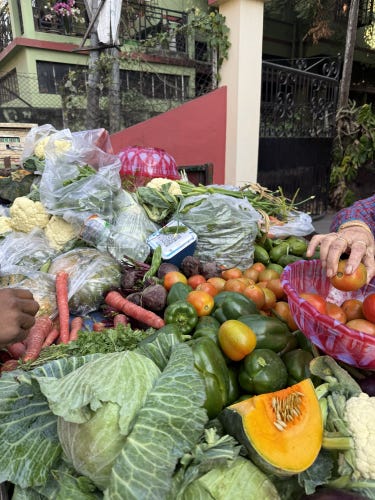
On a winter morning in Guwahati, my mother was doing what she has done for decades — buying vegetables from the vendor who wheels his cart through the neighborhood shouting out to the households to come get his fresh produce. I visit Assam once a year and I still know his name. Manjil! Same ritual, same easy familiarity. He knows what she needs before she asks.
But something was different. Propped between a pile of tomatoes and a head of cauliflower was a small, laminated square. A QR code.
I took a photo immediately. Not because it was surprising, exactly — but because it was perfect.
I spend my professional life writing about digital finance. I work on frameworks, statistical methodologies, policy papers. I sit in rooms with central bankers and talk about interoperability, measurement gaps, and what it means to bring the informal economy into the formal financial system. I use words like “leapfrogging” and cite the BIS: without digital intervention, India would have needed 47 years to get 80% of adults banked. It took one decade.
And here it was. No econometric model required. No footnote. Just a vegetable vendor, a printed QR code, and my mother tapping her phone to pay for green beans at 7am.
This is what fascinates me about digital assets and digital finance — not the technology itself, but what it does. That vendor has no fixed shop, no POS terminal. He has a phone and a QR code that cost him nothing to print. And through that, he is connected to the same payment’s infrastructure used by corporations, governments, and financial institutions. The friction that kept generations of informal workers outside the formal economy including the need for physical infrastructure, minimum balances, documentation, has effectively dissolved.
India’s UPI architecture is the most compelling proof of concept I know. But it’s also just the beginning of a much larger story that I’ve been living professionally for over a decade: how money itself is being redefined, how digital assets, from mobile money to stablecoins to CBDCs, are rewriting the rules of who gets to participate in the financial system, and how we even measure that participation.
When Manjil started accepting digital payments, something quiet but significant happened — he entered the formal financial system. He has a bank account. His transactions are recorded. He shows up in the data now in a way he never did before. That is the whole point. But understanding how that fits into the bigger picture — how it flows through our monetary statistics, our financial accounts, the frameworks that policymakers rely on — that is the work. And that is where I've spent much of my career.
This Substack is my attempt to bridge those two worlds: the vivid, human reality of digital finance and AI transforming everyday life, and the harder, quieter work of turning that transformation into policy that works and data that tells the truth.
I’ll write about both. And I’ll probably start most of it the same way I started this: by noticing something that shouldn’t be remarkable and realizing it changes everything.